
How 5G RedCap quietly fixes the luxury smartwatch’s biggest flaw
Cellular luxury smartwatches always promised freedom from the phone, yet their connectivity rarely felt truly smart. When you enabled 4G LTE on a stainless steel or titanium flagship watch, battery life collapsed and the device throttled performance to survive the day. 5G RedCap luxury smartwatch connectivity changes that equation by using reduced capability radio profiles that keep power consumption ultra low while still delivering meaningful bandwidth.
RedCap, short for reduced capability, is a 5G profile defined in the 3GPP Release 17 specifications for wearables and IoT devices that do not need full enhanced mobile broadband speeds. Instead of chasing gigabit peaks, RedCap technology focuses on balanced performance with typical downlink rates in the 50–150 Mbps range and uplink speeds around 10–50 Mbps that are making ideal trade offs for compact form factors. In practice, that means a watch can stay connected to the 5G network all day, maintain real time health uploads, and still feel like a refined mechanical piece rather than a hot slab of silicon on your wrist.
Early industry roadmaps suggest that upcoming high end smartwatches will be among the first premium wearables with native 5G RedCap support on advanced Snapdragon Wear platforms built on leading edge process nodes. That platform integration matters, because it lets the modem, CPU, and sensor hub coordinate ultra low power states instead of fighting each other for battery. For affluent buyers who already own mechanical icons from Patek Philippe or Audemars Piguet, this kind of invisible connectivity engineering is what finally makes a connected device worthy of sharing wrist time.
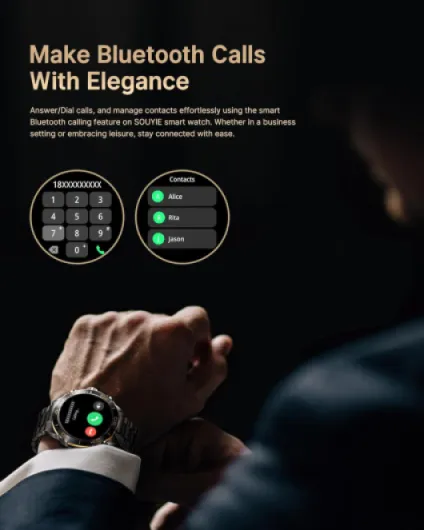
- + 1.43-inch AMOLED HD display for crisp visuals
- + Call support (answer/make calls) compatible with Android and iPhone
- + 400mAh battery for extended usage
- + Comprehensive health tracking: heart rate, blood oxygen (SpO2), blood pressure, sleep monitor, pedometer
- + Includes 2 straps for style or replacement (black)

RedCap versus LTE: what changes when the radio is designed for your wrist
Most LTE IoT implementations in watches were compromises, bolting a smartphone class LTE Cat modem onto a tiny battery and hoping software would mask the physics. When LTE Cat 4 or similar profiles stayed active, even briefly, power consumption spiked and the watch fell back to aggressive LTE fallback strategies that disabled features. 5G RedCap luxury smartwatch connectivity starts from the opposite premise, using reduced capability profiles that are making ideal use of spectrum while respecting the energy budget of wearable devices.
On paper, RedCap sits between legacy LTE IoT and full 5G enhanced broadband, offering tens to low hundreds of Mbps downlink and roughly 10–50 Mbps uplink rather than hundreds. In reality, that is exactly the performance envelope a luxury smartwatch needs for high performance messaging, crisp voice calls, and continuous health telemetry without overkill. Compared with 4G LTE, latency improves, indoor coverage in dense urban network deployments gets better, and the watch can maintain a private connection to cloud IoT applications without constantly negotiating LTE fallback or switching radio bands.
For context, think of RedCap as the connectivity equivalent of carefully tuned complications in a dress watch rather than a bulky chronograph. The radio path is simplified, antenna design can be optimized for premium metal and ceramic form factors, and integration with the Snapdragon Wear platform allows smarter thermal management and slimmer cases. If you are interested in how similar trade offs play out in other luxury wearables, the analysis of AR glasses priced as luxury objects shows the same pattern, where the right balance of performance and cost matters more than headline speeds.

- + 1.19" AMOLED display — clear, vibrant screen
- + Heart rate & sleep monitoring for health tracking
- + 107 sports modes for diverse fitness activities
- + Compatible with iOS & Android — wide device support
- + Luxury gold design — stylish and feminine
What 5G RedCap actually enables on a luxury smartwatch
Once 5G RedCap luxury smartwatch connectivity is in place, the feature list stops being a checkbox and starts to feel like a coherent experience. Always on connectivity means the device can stream real time heart rate variability, SpO2, and training load data to cloud IoT applications without waiting for Wi Fi or a tethered phone. That same reduced capability profile still offers enough downlink capacity in the 50–150 Mbps range to handle rich notifications, encrypted messaging, and even lightweight media in a way that feels immediate rather than constrained.
Voice quality is another area where RedCap technology quietly elevates the experience for premium buyers. With more consistent uplink capacity in the 10–50 Mbps uplink range and lower jitter on the network, calls from the watch sound less like an emergency backup and more like a deliberate choice. When paired with private networks in corporate campuses or luxury estates, the watch becomes a serious communication device, not just a novelty for short outings.
App responsiveness also benefits from the tighter integration between the modem, the operating system, and cloud platforms that manage IoT products. A high performance Snapdragon Wear platform can pre fetch data, sync playlists, and update complications in the background while the radio stays in ultra low power states. For collectors who already understand how movement architecture affects a mechanical watch, this kind of systems level refinement echoes the themes explored in analyses of what watch collectors understand about technology that many mainstream reviewers still miss.
From checkbox to differentiator: the luxury angle on RedCap connectivity
For years, cellular connectivity on luxury smartwatches sat in the same category as a tourbillon on a fashion watch, visually impressive but rarely used to its full potential. Affluent buyers paid a higher cost for LTE models in stainless steel or titanium, then disabled the feature after a week because battery life and performance suffered. 5G RedCap luxury smartwatch connectivity, built on reduced capability profiles and low power radios, finally aligns the feature with how this audience actually lives.
Independence from the phone is the real luxury here, not raw Mbps numbers. With RedCap technology, a watch can stay connected to the 5G network during a run along the Hudson, a meeting in a glass walled boardroom, or a weekend on a private yacht without clinging to a smartphone in a pocket. The device remains fully connected for calls, messages, and IoT applications while drawing so little power that all day wear on a compact battery becomes a long term expectation rather than a marketing claim.
This shift also changes how brands position their most expensive connected devices in the market. Instead of selling cellular as an upsell tied to LTE Cat labels and vague promises of high performance, they can talk about specific use cases like secure access to private networks, real time health monitoring, and seamless integration with other IoT devices in a smart home. In that sense, RedCap connectivity becomes part of a broader ecosystem story, similar to how laser PTZ systems for luxury estates turn cameras from security hardware into intelligent, networked guardians.
Carriers, private networks, and the new standalone watch
For 5G RedCap luxury smartwatch connectivity to matter, carriers must actually support the feature on their network infrastructure. Major operators in the United States, such as Verizon and AT&T, have already begun enabling RedCap style profiles in select mid band spectrum, initially targeting industrial IoT products and then extending support to consumer wearables. As these 3GPP Release 17 based upgrades roll out, premium watches with RedCap technology will be able to register as native 5G IoT devices rather than relying on LTE fallback or legacy LTE IoT modes.
Standalone viability depends on more than radio support, though, and this is where private networks enter the conversation. Enterprises and luxury residential developments are deploying private 5G networks that treat watches, AR glasses, and other IoT devices as first class citizens with guaranteed quality of service. In those environments, a RedCap enabled device can handle secure building access, staff coordination, and real time alerts with ultra low latency, making ideal use of the reduced capability profile without wasting spectrum or battery.
For short outings without a phone, the experience finally feels intentional rather than compromised. You can leave your smartphone in the hotel safe, rely on the watch for payments, navigation, and messaging, and trust that the combination of 50–150 Mbps downlink capacity and efficient power consumption will last through dinner and a late walk home. That is the moment when connectivity stops being a spec sheet line and becomes part of the watch’s identity, much like water resistance ratings or movement finishing in traditional horology.
Design, form factors, and the future of RedCap in luxury wearables
RedCap is not just a radio story, it is a design story, because reduced capability profiles free industrial designers from some of the constraints that plagued earlier LTE watches. With lower peak transmit power and more predictable thermal behavior, brands can experiment with slimmer form factors, more intricate case geometry, and exotic materials without compromising comfort. Ceramic bezels, sapphire crystals, and integrated bracelets feel more plausible when the device beneath them is not fighting to dissipate heat from a full 5G modem.
The integration of RedCap technology into the Snapdragon Wear platform also simplifies antenna placement and shielding in metal cases. Instead of carving out awkward plastic windows to satisfy LTE Cat requirements, designers can work with more flexible antenna layouts that respect the visual language of high end timepieces while still meeting 5G wearable performance targets. Over the long term, this should expand the market for truly premium connected devices that look at home next to independent watchmaking pieces rather than mass market gadgets.
IoT applications will follow the hardware, especially as more IoT devices in the home and office speak the same 5G dialect. A RedCap enabled watch can act as a secure key for private networks, a controller for lighting and climate, and a node in a broader mesh of IoT products that share data in real time. When that ecosystem matures, the most interesting question will not be how many Mbps your watch can push, but how gracefully it orchestrates your connected life while still feeling like a piece of jewelry.
Cost, value, and how to judge the next wave of connected luxury watches
Pricing for RedCap enabled luxury smartwatches will inevitably sit at the top of the market, but the value proposition is shifting. Previously, paying extra for LTE meant accepting higher cost, worse battery life, and a feature you rarely used, which is a poor trade for any discerning buyer. With 5G RedCap luxury smartwatch connectivity, the premium goes toward a radio architecture and platform integration that finally align with long term ownership and daily wear.
When evaluating the next generation of devices, focus less on marketing language and more on how the watch behaves as an IoT device in your actual routines. Ask whether the modem supports RedCap profiles natively, how the brand manages LTE fallback when you leave 5G coverage, and whether the watch can maintain real time data flows without hammering power consumption. Pay attention to how the device interacts with other IoT devices in your ecosystem, from cars and headphones to smart home controllers, because that integration will determine whether the watch feels like a hub or just another screen.
It is also worth considering how carriers structure plans for these connected devices, since the recurring cost can quietly erode the appeal of even the most elegant hardware. Look for options that treat RedCap wearables as part of a broader family of IoT products, with shared data and flexible activation rather than rigid, phone centric add ons. In the end, the real luxury is not just owning a high performance object, but owning one whose connectivity, design, and ecosystem are making ideal sense together every time you fasten the clasp.
Key figures on 5G RedCap and luxury smartwatch connectivity
- According to 3GPP specifications in Release 17, 5G RedCap targets peak data rates in the range of tens to low hundreds of megabits per second, which is sufficient for real time health data, messaging, and voice on wearables without the energy overhead of full enhanced mobile broadband. Readers can consult the official 3GPP Release 17 technical reports for the precise radio profiles and bandwidth configurations.
- Industry analyses from major network equipment vendors indicate that RedCap devices can reduce power consumption by up to around 60 percent compared with equivalent LTE Cat M implementations in similar IoT devices, a shift that directly benefits smartwatch battery life. This figure should be treated as an industry estimate based on vendor whitepapers and lab measurements rather than a universal guarantee.
- Global mobile operators have announced RedCap trials and early deployments across multiple regions, with several large carriers in North America and Asia planning commercial support for wearables and IoT products as part of their mid band 5G rollouts. Public trial announcements from these carriers and their infrastructure partners provide the clearest view of timelines and coverage.
- Market forecasts from telecom research firms project that RedCap capable IoT devices, including wearables, could account for a significant share of new cellular IoT connections within a few years, reflecting strong interest in reduced capability profiles for low power applications. These projections are typically published in annual cellular IoT outlooks and 5G RedCap adoption reports.
- Chipset roadmaps from leading silicon vendors show that RedCap support is being integrated into next generation wearable platforms on advanced process nodes, enabling smaller form factors and more efficient thermal management in premium smartwatches. Investors and developers can track these trends through official chipset launch presentations and technical briefs.
FAQ about 5G RedCap luxury smartwatch connectivity
How is 5G RedCap different from regular 5G on a smartwatch ?
5G RedCap uses reduced capability profiles that limit peak speeds but dramatically improve power efficiency, which suits compact devices like watches. Instead of chasing gigabit throughput, it focuses on tens to low hundreds of megabits per second, enough for health data, messaging, and voice. This balance allows a luxury smartwatch to stay connected all day without the battery penalties of a full 5G modem.
Will my carrier support a RedCap enabled luxury smartwatch ?
Support depends on whether your carrier has enabled RedCap profiles on its 5G network and certified specific devices. Large operators in the United States are beginning to roll out RedCap for IoT and wearable use cases, starting in major cities and high traffic corridors. Before buying, you should confirm that both the watch and your carrier’s plan explicitly mention 5G RedCap support.
Does RedCap make a cellular watch truly usable without a phone ?
RedCap makes standalone use far more practical by combining lower latency, adequate bandwidth, and much better battery life than LTE based watches. For short outings, workouts, or evenings out, a RedCap enabled watch can handle calls, messages, and streaming health data reliably. For extended travel, most users will still prefer to keep a phone nearby for larger screens and heavier apps.
How does 5G RedCap affect the design and comfort of luxury watches ?
Because RedCap radios run cooler and draw less power, designers can work with slimmer cases, more metal, and more ambitious form factors without overheating the wrist. Antenna layouts become easier to integrate into ceramic, titanium, and steel designs that match traditional luxury aesthetics while still meeting 5G wearable requirements. Over time, this should lead to connected watches that feel closer to fine mechanical pieces than to miniaturized smartphones.
Is paying extra for RedCap connectivity on a luxury smartwatch worth it ?
The premium makes sense if you value independence from your phone and plan to use cellular features regularly. Unlike earlier LTE options, RedCap connectivity is designed for long term daily use, with better power consumption and more reliable performance. For occasional users who rarely leave their phone behind, Wi Fi only models may still offer better value.