Summary
Editor's rating
Audio: clean but too quiet, Whisper Mode is a mixed bag
Value: fair for what it does, but not a no‑brainer
Design: looks techy, feels mostly solid, with some quirks
Comfort: okay for a movie, not something I’d wear all day
Durability & packaging: feels decent, but you’ll want to baby it
Performance: strong image and tracking, but not perfect optics
What the RayNeo GT Max actually is (and isn’t)
Pros
- Very good central image quality with bright MicroOLED and 120Hz, great for movies and gaming
- Wide 59° FOV gives a genuinely large-feeling virtual screen (up to ~267" equivalent)
- Simple plug-and-play with many USB‑C devices (phones, laptops, Steam Deck, Switch, PS5 with adapter)
Cons
- Blur and distortion at the edges, especially noticeable in fixed screen mode
- Audio is clear but too quiet in noisy environments, with limited bass
- Comfort is just okay for long sessions; weight on the nose and light leakage can be tiring

Specifications
View full product page →| Brand | RayNeo |
Cinema on your nose… kind of
I’ve been using the RayNeo GT Max AR/XR glasses for a bit now as a portable screen for movies, gaming and some light work. I mainly plugged them into a Steam Deck, a gaming laptop, an Android phone and a Switch. I went in pretty hyped by the specs: 59° FOV, 120Hz, Dolby stuff, 3DoF head tracking, audio by Bang & Olufsen… on paper it sounds like a compact home cinema you strap to your face.
In practice, it’s more down to earth. The image is genuinely good, the virtual screen feels big, and for watching Netflix or YouTube in bed or on the sofa, it’s pretty solid. But it’s not magic. There are some quirks with edge clarity, comfort over longer sessions and sound volume that keep it from being the perfect all-round screen. It’s good, but the hype is clearly above what you actually get.
Compared to other AR glasses I’ve tried (Xreal/Air-type stuff and a competitor often called “Beast”), the GT Max pushes a wider field of view and nicer tracking, but it also brings slightly more optical compromises. I’d say it’s better than the basic cheap AR glasses out there, but it’s not miles ahead of the mid/high-range alternatives. You really have to know what you want to use it for.
If you’re expecting a full VR headset replacement or some sci‑fi mixed reality setup, that’s not what this is. Think of it as a fancy external monitor that you wear instead of putting on your desk. For travel, late-night movies without bothering anyone, and some casual gaming, it does the job nicely. For picky users who stare at image edges and care a lot about audio, you’ll probably spot the weak spots quickly.
Audio: clean but too quiet, Whisper Mode is a mixed bag
The audio side is one of the areas where the marketing sounds stronger than the reality. The speakers are tuned with Bang & Olufsen and use a “Racetrack Quad-Speaker” setup. In practice, the sound is clear, and you get a decent sense of stereo and some spatial effects when content supports it. For watching YouTube or a show in a quiet room, it’s perfectly fine. You can hear voices clearly, and there’s enough detail for films and casual gaming.
The main problem is volume. Several Amazon buyers mentioned it, and I had the same feeling: even at max volume, it’s on the quiet side, especially if there’s background noise (plane, train, people talking). Indoors at night it’s okay, but if you’re in a noisy environment, you’ll quickly wish it could go a notch or two louder. Bass is also limited, which is normal for tiny speakers by your ears, but it means explosions and music don’t hit very hard. It’s serviceable, but don’t expect anything close to good headphones.
Whisper Mode 2.0 is meant to reduce sound leakage so people around you hear less of what you’re listening to. It works to a point – it’s not blaring out like a phone on loudspeaker – but in a very quiet room someone close by can still hear enough to know what you’re watching. For me, it’s fine for watching stuff next to someone who’s dozing off, as long as the volume isn’t maxed out. If you really want privacy or higher volume, you’ll probably end up using separate earbuds or headphones plugged into your source device.
The spatial audio with head tracking is fun for certain content (concerts, some games, surround mixes), but again, it’s more of a nice extra than a killer feature. You notice sounds moving around your head a bit more, but the limited volume and bass kind of hold it back. Bottom line: the audio “by B&O” sounds like marketing, but the real-world result is decent, clear, a bit too quiet, and good enough for casual use. For serious gaming or movies, I often preferred pairing Bluetooth earbuds to the phone/console and just using the glasses as a screen.
Value: fair for what it does, but not a no‑brainer
In terms of value, the GT Max sits in that “not cheap, not insane” category. It’s clearly more expensive than basic AR glasses with smaller FOV and simpler audio, but it also gives you a bigger virtual screen, 120Hz, better colours, spatial tracking and Dolby Vision support (with the right RayNeo box). If you actually use those features – especially the wider FOV and smooth 120Hz for gaming – you do feel where some of the extra money went.
However, when you compare it to competitors, it’s not a clear slam dunk. Some other models have slightly better edge clarity but a bit smaller FOV. Others are cheaper but don’t have the head tracking or fancy audio tuning. The GT Max lands somewhere in the middle: it’s strong on specs and overall picture, but the edge blur, modest audio volume and comfort limitations hold it back from being an obvious “just buy this one” choice. Given that user reviews sit around 4.1/5, that lines up with my experience: good product, not flawless.
Where it starts to feel like decent value is if you travel a lot, watch a ton of content in bed or on the couch, or use a Steam Deck/Switch regularly. In those cases, it really can replace a TV or monitor in many situations. I found it handy for watching YouTube in bed without lighting up the whole room, and for playing on the Deck with a bigger-feeling screen. If you only watch a couple of movies a month or mostly sit in front of a regular TV anyway, the money might be better spent on a bigger real screen or better headphones.
So overall, I’d call the value “pretty solid if you know what you’re buying it for.” It’s not a bargain, but it’s not overpriced for the tech it offers. Just don’t go in expecting perfection or believing the hype that it’s going to replace every screen you own. If your main goal is a portable big screen with good image quality and you can live with average audio and some optical quirks, the price makes sense. If you’re super picky or on a tight budget, I’d look hard at alternatives or wait for a deal.
Design: looks techy, feels mostly solid, with some quirks
Design-wise, the GT Max sits in that middle zone: not as bulky as full VR goggles, but definitely still “tech glasses” and not something you’d mistake for normal eyewear. The front is a bit chunky because of the optics and speakers, and once you put them on, people will clearly see you’re wearing a gadget, not prescription glasses. Personally, I don’t care much about looks at home or on a plane, but I wouldn’t walk around town with them on for long.
The build feels decent: plastics feel dense enough, the hinges move smoothly, and nothing rattles. It doesn’t scream cheap, but it also doesn’t feel ultra premium like high-end audio headphones. I’d call it solid mid-range hardware. The cable plugs into the temple and sits reasonably flush. One thing I liked is that they didn’t overcomplicate the controls: you don’t have 15 touch gestures to memorize. Basic buttons, simple operation, plug-and-play with most devices. That part is simple and practical.
However, design choices do affect the experience. The wide FOV means the lenses are quite large, and that’s where some of the edge clarity issues show up. When you look dead center, the image is sharp; when your eyes drift to the far edges, you can see blur and distortion, and in fixed mode you literally see the edges come into focus as you move your head. It’s not unusable, but if you’re sensitive to that kind of thing, you’ll notice it a lot in menus or games with HUD elements in the corners.
Another design point: light leakage. The glasses are quite open on the sides and bottom, so in a bright room you’ll always have some ambient light coming in. This doesn’t kill the image, since the panels are bright, but it does reduce the “cinema” feel and can be distracting, especially for dark movies. In a dim room or at night it’s much better. Overall, the design gets the job done, but it’s clearly focused on functionality over style, and it comes with some compromises on immersion and optics.
Comfort: okay for a movie, not something I’d wear all day
Comfort is where things get a bit mixed. The GT Max is fairly light compared to VR headsets, but it still puts most of the weight on your nose and a bit on your ears. At first it feels fine, but after an hour or so, I started to feel pressure on the bridge of my nose, especially because the glasses don’t naturally sit super low – they tend to rest a bit higher, like one Amazon review mentioned. If your nose is narrow or the pads don’t match your face well, you’ll notice it even faster.
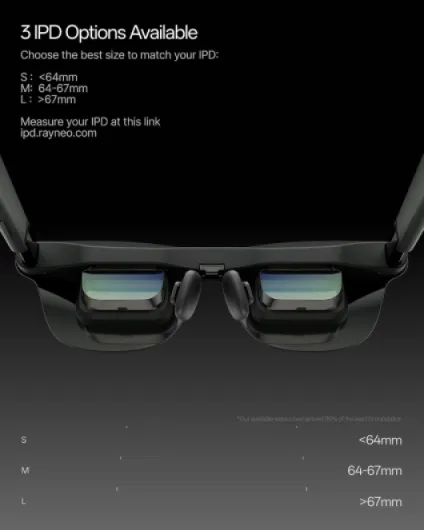
The IPD sizing is a good idea in theory. You pick S, M or L based on your interpupillary distance (S under 64mm, M 64–67mm, L above 67mm). I used the M model. When your IPD is close to the right size, the center sharpness is great and you don’t feel like you’re crossing your eyes. But it also means you absolutely need to measure your IPD before buying. If you guess and get it wrong, you’ll probably end up with eye strain or poor clarity. Compared to AR glasses where you can manually adjust IPD, this fixed-size approach is more locked in.
As for wearing them in different situations: in bed, half lying down, they’re decent for a couple of episodes or some YouTube. On a sofa, no problem. On a plane or train, it depends a lot on how the seat pushes on the arms and how long you keep them on. I personally wouldn’t binge three full movies in a row with these; my nose and ears would complain. For 60–90 minutes at a time, it’s fine. After that, I usually want a break, even though my eyes themselves feel okay thanks to the high refresh rate and the dimming tech.
The light leakage from the sides and bottom doesn’t help with comfort either, not physically but mentally. You’re always a bit aware of your surroundings, which can be good for safety, but if you’re trying to get lost in a movie, the stray light and visible room can be distracting. In a dark environment, this problem basically goes away and the glasses feel much nicer to use. Overall: comfort is acceptable, but if you’re sensitive to weight on your nose or you want to use them for very long sessions, I’d keep expectations realistic.
Durability & packaging: feels decent, but you’ll want to baby it
On durability, I obviously can’t simulate two years of use in a short test, but I can comment on how it feels and how it’s holding up so far. The frame and arms feel fairly sturdy for this type of product. They don’t creak when you open them, and the hinges don’t feel like they’ll snap right away. That said, these are still glasses with electronics and optics in them, not a rugged device. If you throw them in a bag without a case, they’re going to get scratched, bent or worse sooner or later.
The included packaging and presentation are on the premium side. The box looks nice, the glasses are well protected, and the first impression is good. It gives the feeling of a higher-end gadget, which matches the price point. The downside is, once you take them out and start using them daily, you realize they’re not built to survive rough handling. The lenses need regular cleaning, and you have to be careful not to press on them too hard. I’d definitely keep the case and use it religiously if you plan to travel with them.
There’s a 2‑year manufacturer warranty, which is reassuring. For a product full of tiny components – MicroOLED screens, tracking sensors, multiple chips – having that warranty is important. I haven’t had any hardware issues yet: no dead pixels, no tracking failures, no random disconnects. The USB‑C connector feels solid enough, but again, this is a potential weak point over the long run if you’re constantly plugging and unplugging. I’d avoid yanking the cable or letting it bend sharply at the port.
Overall, I’d say durability is “good if you’re careful.” It’s not flimsy, but it’s not something I’d hand to kids or toss around. Treat it like an expensive pair of headphones with glass parts: use the case, don’t twist the arms, and don’t leave it in a hot car. Do that, and with the 2‑year warranty as backup, you’re probably fine. If you’re rough on your gear, though, this kind of product in general may frustrate you.

Performance: strong image and tracking, but not perfect optics
On pure performance, the GT Max is pretty solid. The MicroOLED panels are sharp, the colours look good, and the brightness is more than enough indoors. The claimed 1200 nits “perceived” brightness basically means you don’t feel like the image is dim, even with some room light. Blacks are deep enough that dark scenes in movies don’t look washed out like on a cheap LCD. For watching films and series, I had no complaints about the core image quality in the center of the screen.
The 120Hz refresh rate is a real plus for gaming and fast content. On a Steam Deck and PC, everything felt smooth, and motion blur wasn’t a problem. You notice the difference if you switch back to a 60Hz device. The 3DoF head tracking also does what it says: the virtual screen can stay fixed in space even when you move your head around. I found “Steady” and “Pinned” modes the most useful – you can look around a bit without the screen following every tiny movement, which feels more natural. Latency was low enough that I didn’t get motion sickness or weird lag when turning my head.
Where performance drops a bit is the optical clarity at the edges. Like one Amazon reviewer said, in fixed mode you can see the edges go in and out of focus as you move your head. HUD elements or subtitles very close to the borders can look softer than the center. Compared to another big-FOV pair I tried (often nicknamed the “Beast”), I’d say the GT Max gives a wider view but pays for it with more noticeable blur at the sides. If you mostly stare at the center – movies, most console games – it’s fine. If you’re picky and constantly scan the whole image, it can get annoying.
The 3D and 2D‑to‑3D conversion is a nice extra but not something I used constantly. Native 3D content looks cool and does add depth when it’s done properly. The automatic 2D‑to‑3D is more of a fun bonus: sometimes it looks decent, sometimes it feels a bit fake. I wouldn’t buy the glasses just for that, but as an add-on it’s okay. Overall, performance is good enough that I kept using them for films and handheld gaming, but it’s not flawless, especially if you’re very sensitive to edge quality.
What the RayNeo GT Max actually is (and isn’t)
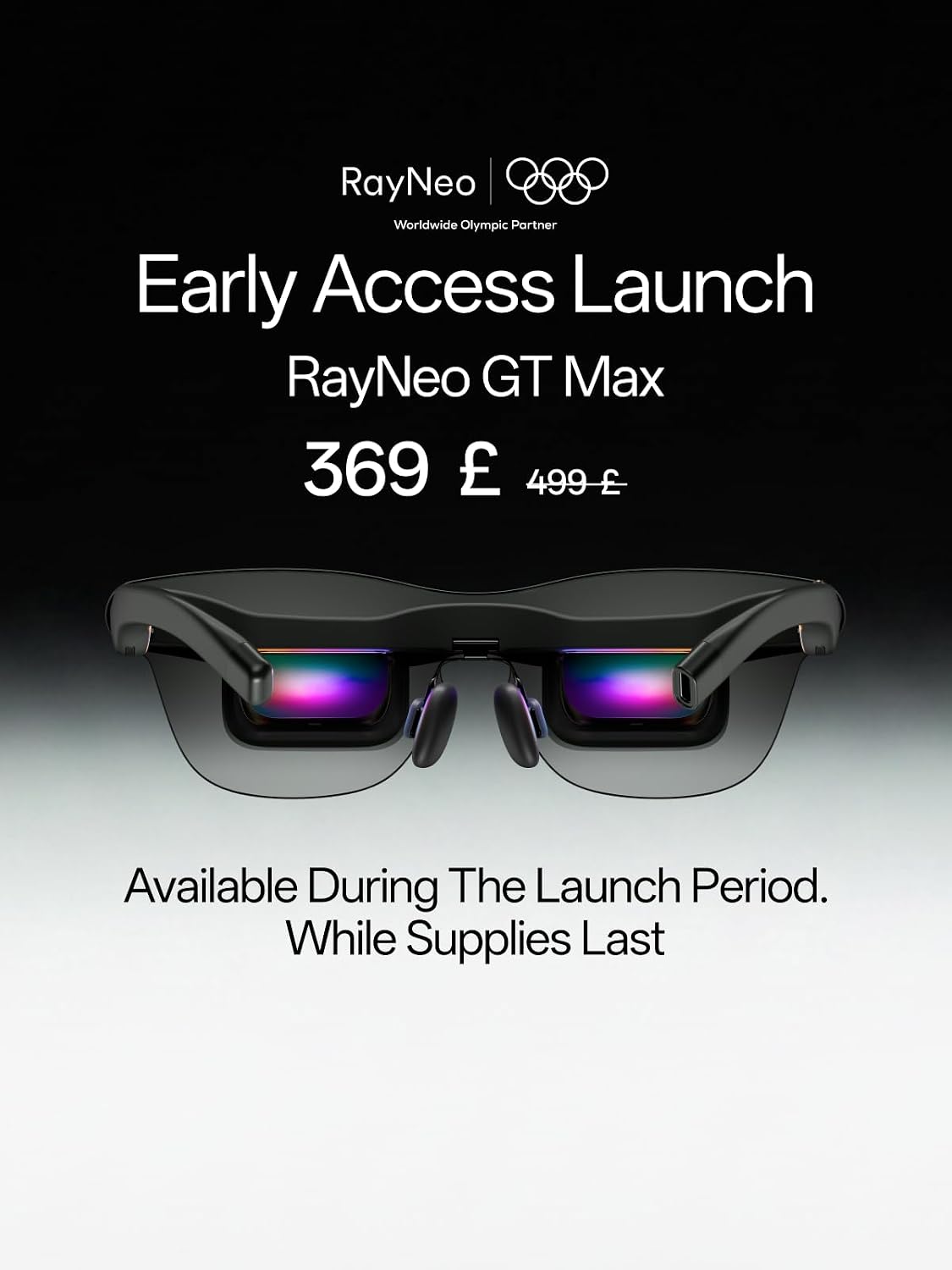
The GT Max is basically a pair of AR glasses that act like a USB‑C external display. You plug them into a phone, laptop, console or handheld and they show a giant virtual screen in front of you. That’s it. No separate box needed, no Android OS built in, no standalone apps. It’s more like a head‑mounted monitor with some extra tricks: 3DoF head tracking, spatial audio, and 2D‑to‑3D conversion. The advertised 267" screen and 59° FOV just mean the image feels big, like sitting fairly close to a big TV or projector.
On the compatibility side, it’s pretty generous. It works with Android phones that support video over USB‑C, iPhone 15 and newer (because of USB‑C and DisplayPort), modern iPads and Macs, Windows laptops, Steam Deck, Switch, and PS5 (with the right adapter). Just keep in mind: if your device doesn’t push video over USB‑C, you’ll need a hub or HDMI adapter that converts to USB‑C DisplayPort. That’s not RayNeo’s fault, but it’s something you need to plan for. I had to dig out an adapter for an older laptop and an older iPad simply wouldn’t work.
The big selling points on the spec sheet are: MicroOLED panels, up to 120Hz refresh rate, 1200 nits perceived brightness, 145% sRGB, 98% DCI-P3, and the dual‑chip setup (one for image, one for tracking). In everyday use, what you actually feel is: bright image, good colours, smooth motion, and a screen that doesn’t drift around when you move your head. The rest of the numbers are nice, but you don’t sit there thinking “ah yes, 200,000:1 contrast,” you just notice that blacks look decent and movies pop.
One important detail: this is the type of product that really depends on your expectations. If you just want a private, big screen for Netflix, YouTube, or plugging into a Switch or Steam Deck, it fits that role pretty well. If you’re buying it expecting full mixed reality apps like on a Vision Pro or a full VR system, you’re going to be disappointed. It’s display-first, with a bit of AR/XR flavor thanks to the tracking and 3D features, not a full spatial computer.
Pros
- Very good central image quality with bright MicroOLED and 120Hz, great for movies and gaming
- Wide 59° FOV gives a genuinely large-feeling virtual screen (up to ~267" equivalent)
- Simple plug-and-play with many USB‑C devices (phones, laptops, Steam Deck, Switch, PS5 with adapter)
Cons
- Blur and distortion at the edges, especially noticeable in fixed screen mode
- Audio is clear but too quiet in noisy environments, with limited bass
- Comfort is just okay for long sessions; weight on the nose and light leakage can be tiring
Conclusion
Editor's rating
Overall, the RayNeo GT Max is a good portable screen for people who really want a big, private display for movies and gaming, but it’s not flawless. The central image quality, brightness, and 120Hz refresh rate are genuinely nice, and the wide FOV does make content feel more immersive than smaller AR glasses. The head tracking works well enough that the screen doesn’t feel like it’s sliding around, and for everyday use with a Steam Deck, Switch, laptop or modern phone, the plug‑and‑play side is pretty painless.
On the other hand, the downsides are real: edge clarity isn’t great, comfort is decent but not “forget you’re wearing it,” and the audio is clear but too quiet for noisy environments. Light leakage means you’ll enjoy it most in dim rooms, not bright spaces. Compared to other options, it’s in a fair spot: better than entry‑level stuff, but not perfect enough to blow everything else away. If you travel a lot, watch a lot of content in bed, or want a big virtual screen for handheld gaming and you’re okay with some compromises, it’s a solid pick. If you’re very sensitive to optical flaws, want loud, punchy audio, or expect a full VR/MR system, I’d skip it or at least try it with a good return policy.