Summary
Editor's rating
Value: powerful but pricey, and not for everyone
Chunky cushion design: looks tough, feels big
Battery life: decent, not a multi-day monster
Comfort: fine for medium wrists, borderline for smaller ones
Titanium case and marine band: tough but not luxury-jewellery
Performance and features: fast, packed, but app-juggling
What you actually get with this Galaxy Watch Ultra
Pros
- Robust titanium build with bright 1.5" AMOLED screen and 3000-nit visibility
- Strong fitness and health tracking with fast auto-detected walks and detailed sleep data
- LTE, Samsung Pay, and quick button make it practical as a phone companion or occasional phone replacement
Cons
- Battery life around 1.5–2 days with full features, far from the advertised 13-day figure in real use
- Complex setup and app ecosystem (Wearable, Health, Health Monitor) plus eSIM depends on carrier support
- Large 47mm case and chunky band can feel bulky and uncomfortable on smaller wrists

Specifications
View full product page →| Brand | Samsung |
Big, smart, and a bit overcomplicated
I’ve been using the Samsung Galaxy Watch Ultra (2025) in Titanium Dark Grey with the orange marine band for a bit now, paired with a Samsung phone. I’m not a collector or a tech reviewer by trade, I just like gadgets that make daily life easier and track my health without me babysitting them all day. I’ve owned a couple of Galaxy Watches before (including the Watch 4 and Watch 6), plus an Apple Watch at one point, so I’ve got a decent idea of what’s normal and what’s just annoying.
The short version: this watch is powerful and packed with features, but it’s also big on the wrist, the setup is more faff than it should be, and the battery life is good but not mind-blowing. It sits somewhere between a fitness watch and a tiny phone on your wrist. If you’re already in the Samsung ecosystem and you like playing with health stats, you’ll probably enjoy it. If you just want something simple that lasts a week without charging, this is not that.
What really stands out in daily use is how quickly it picks up walks and workouts, how bright the screen is outdoors, and how smooth the interface feels with One UI 8. On the flip side, you’re dealing with multiple Samsung apps, eSIM setup that depends on your mobile provider actually supporting it, and a watch that you will feel on your wrist if you’ve got smaller arms. It’s not a discreet little bracelet, it’s a proper chunk of tech.
In this review I’ll go through what it’s like to actually live with it: how it looks, how it feels, how long it lasts, and whether I think it’s worth the asking price compared to cheaper Galaxy models or rivals from “California and Beijing”, as one of the Amazon reviewers politely put it. I’m not going to dress it up: it’s good in several areas, but there are clear trade-offs you should know before throwing that much money at a watch.
Value: powerful but pricey, and not for everyone
In terms of value, this watch sits at the expensive end of the Android smartwatch market. You’re paying for titanium, LTE, dual GPS, 64 GB of storage, and a big bright AMOLED screen that hits up to 3000 nits. On top of that, there’s the 3-year extended warranty, which is reassuring if you’re rough on your gear. If you compare it to cheaper Galaxy models (non-Ultra), you’re mostly paying extra for the materials, size, LTE, and some of the more advanced training and health features.
If you actually use those extras—like leaving your phone at home while running with LTE, digging into advanced running metrics, or relying on detailed sleep and vascular load tracking—then it starts to make sense. For someone who’s already deep in the Samsung ecosystem, has a compatible phone, and likes to tinker with settings and stats, the watch feels like a strong all-in-one tool. In that case, the price is high but not insane, especially if you catch it on sale like one of the Amazon reviewers did.
But if you mostly want notifications, basic fitness tracking, and contactless payments, the cheaper non-Ultra Galaxy Watches give you a big chunk of that experience for less money. One of the Amazon reviews basically said they’d recommend the non-Ultra to save cash, and I think that’s a fair take. The Ultra is overkill for casual users who rarely run with just the watch or who don’t care about dual GPS or long lists of health metrics.
Overall, I’d call the value good only if you’re the target user: Android (ideally Samsung) phone owner, likes a big watch, cares about LTE and advanced tracking, and is okay dealing with multiple Samsung apps and regular charging. For everyone else, it’s a nice piece of kit but probably more money and complexity than you actually need on your wrist.
Chunky cushion design: looks tough, feels big
The design is what you notice first: this thing is big and quite bold. The 47mm cushion-style case with the rotating bezel gives it that rugged, outdoorsy look. On my medium wrist it looks like a proper sports watch, not a fashion accessory. If you’ve used a smaller Galaxy Watch or something like a Fitbit, this will feel like a big step up in size. For some people that’s good (easy to read, more presence), for others it’s going to be borderline too much.
The rotating bezel is still one of the best parts of Samsung’s design. Scrolling through menus with the bezel feels natural, and you’re not constantly smudging the screen with your fingers. Combine that with the new One UI 8 multi-info tiles and the Now bar and you can move around the watch pretty quickly. I found myself using the bezel for most navigation and only tapping the screen when needed, which is nice when you’re sweaty or in the rain.
The Quick Button on the side is handy in theory: you can map it to workouts, shortcuts, or whatever you use a lot. In practice, it took me a few days to make it muscle memory. When I finally set it to start my most-used exercise and double-press for a custom function, it genuinely cut down the faffing before a run or a walk. It’s not revolutionary, but it’s one of those small things that makes the watch feel more like a tool than a toy.
Visually, the Titanium Dark Grey case with the orange marine band has that “I hike on weekends” look, even if you don’t. Personally I liked it for casual wear and workouts, but it stands out in an office. Compared to my old Watch 6, it looks more serious and more rugged. If you prefer something low profile under a shirt cuff, this is probably not it. If you want a big, clear screen and a watch that looks like gear rather than jewelry, the design makes sense.
Battery life: decent, not a multi-day monster
Battery is where expectations and reality can clash a bit. Samsung advertises up to around 13 days of battery life, but that’s clearly under ideal, stripped-down conditions. In normal daily use with Always-On Display (AOD) on, LTE connected, notifications, workouts, and sleep tracking, I was getting more like 1.5 to 2 days, which lines up with the more critical Amazon review. If I turned AOD off and used power saving modes, I could stretch it to around 3 days, but that meant compromising on some of the nice features.
One user mentioned running it mostly in Power Saving mode and only disabling that for sleep, getting a “couple of days” out of it. That’s pretty much my experience too. If you’re happy to tweak settings—dim the screen a bit, limit background activity, and not constantly use LTE—then you can get something reasonable. But if you go all-in with bright screen, AOD, LTE, GPS workouts, and all the bells and whistles, you’re going to be charging it roughly every day or day and a half.
Charging itself is straightforward but not lightning fast. Topping it up from around 20% to 80% is manageable during a shower and breakfast, which is what I ended up doing. Samsung recommends not always charging to 100% for battery health, but if you follow that advice and keep it around 80%, you’re basically in a daily charge routine if you’re a heavier user. For a watch in this price range, it’s okay but not standout, especially when some rivals manage longer runtimes with similar features.
So, is the battery a deal-breaker? For me, no, but it’s not a strong selling point either. If you’re coming from an Apple Watch or older Galaxy Watch, it’ll feel familiar: roughly one to two days with full features. If you’re used to a Garmin or a simpler fitness tracker that lasts a week or more, this will feel like a step backwards. It’s fine if you accept that frequent charging is part of the smartwatch lifestyle, but don’t expect the marketing ‘up to 13 days’ to reflect real-world heavy use.
Comfort: fine for medium wrists, borderline for smaller ones
Comfort-wise, this watch is a bit of a trade-off. The good news is that the marine band is flexible and doesn’t pinch, and the Dynamic Lug System helps the watch sit flatter on the wrist instead of sticking out like a brick. I wore it all day, including at the desk and on walks, and once I found the right notch on the strap it stayed put without me constantly adjusting it. It doesn’t bite into the skin, even when you tighten it for more accurate heart-rate tracking.
The less good news is the sheer size and weight. At around 47mm with a titanium case and a big screen, you feel it. If you’ve only ever used slim trackers before, this will feel like strapping a small puck to your arm. During workouts it’s fine, and actually helpful because the screen is easy to read mid-run. But when you’re sleeping or typing at a laptop, you’ll occasionally notice it pressing against the mattress or the edge of the desk. After a few nights, I got used to it, but the first two nights of sleep tracking felt a bit awkward.
Another thing: if you wear tighter sleeves or jackets, the watch tends to catch on the fabric. The orange band also doesn’t glide under cuffs as smoothly as a smoother silicone or fabric band. Not a massive issue, but something you notice in day-to-day life. I ended up loosening it half a notch when at work, then tightening it again for workouts and sleep, which is not a huge deal but is one more thing to remember.
In terms of sizing, the S/M/L band is supposed to cover 160 to 205 mm wrists. On my medium wrist, it’s fine. On smaller wrists, this watch will likely look and feel oversized. If you’re used to bigger sports watches (Garmin, older Galaxy Watch Classic, etc.), you’ll probably be okay. If you’re coming from a slim smartwatch or a bracelet-style tracker, I’d honestly say try it on in a store first if you can. Comfort is decent once you’re used to the bulk, but it’s definitely not a “forget it’s there” kind of device.
Titanium case and marine band: tough but not luxury-jewellery
The materials are one of the selling points. The case is titanium, which keeps the weight reasonable for the size and gives it a solid, slightly matte look. It doesn’t feel cheap at all. After daily use, including a few bumps against door frames and gym equipment, I didn’t see any obvious dings or scratches on the body. It feels like it can handle normal clumsy human behaviour without you babying it every second.
The orange marine band is where things get a bit mixed. On the plus side, it’s clearly built for sweat, water, and sport. It dries quickly, doesn’t soak up sweat like some fabric bands, and the new Dynamic Lug System makes swapping bands easier. The quick-click mechanism is straightforward: you press, slide, and it locks in. Compared to the older Galaxy Watch 6 bands I used, this is less fiddly and feels more secure. I never felt like the band was about to pop off while running or lifting.
On the downside, the band gets grubby. Bright orange looks cool out of the box, but after a few days of workouts, sunscreen, and daily use, it started picking up marks. A quick wash under the tap usually sorted it out, but you need to accept you’ll be cleaning it now and then. Also, the band is technically S/M/L in one, fitting 160 to 205 mm wrists. That’s flexible, but if you’ve got very small wrists, even the tightest setting might still feel a bit bulky and leave extra strap flapping around.
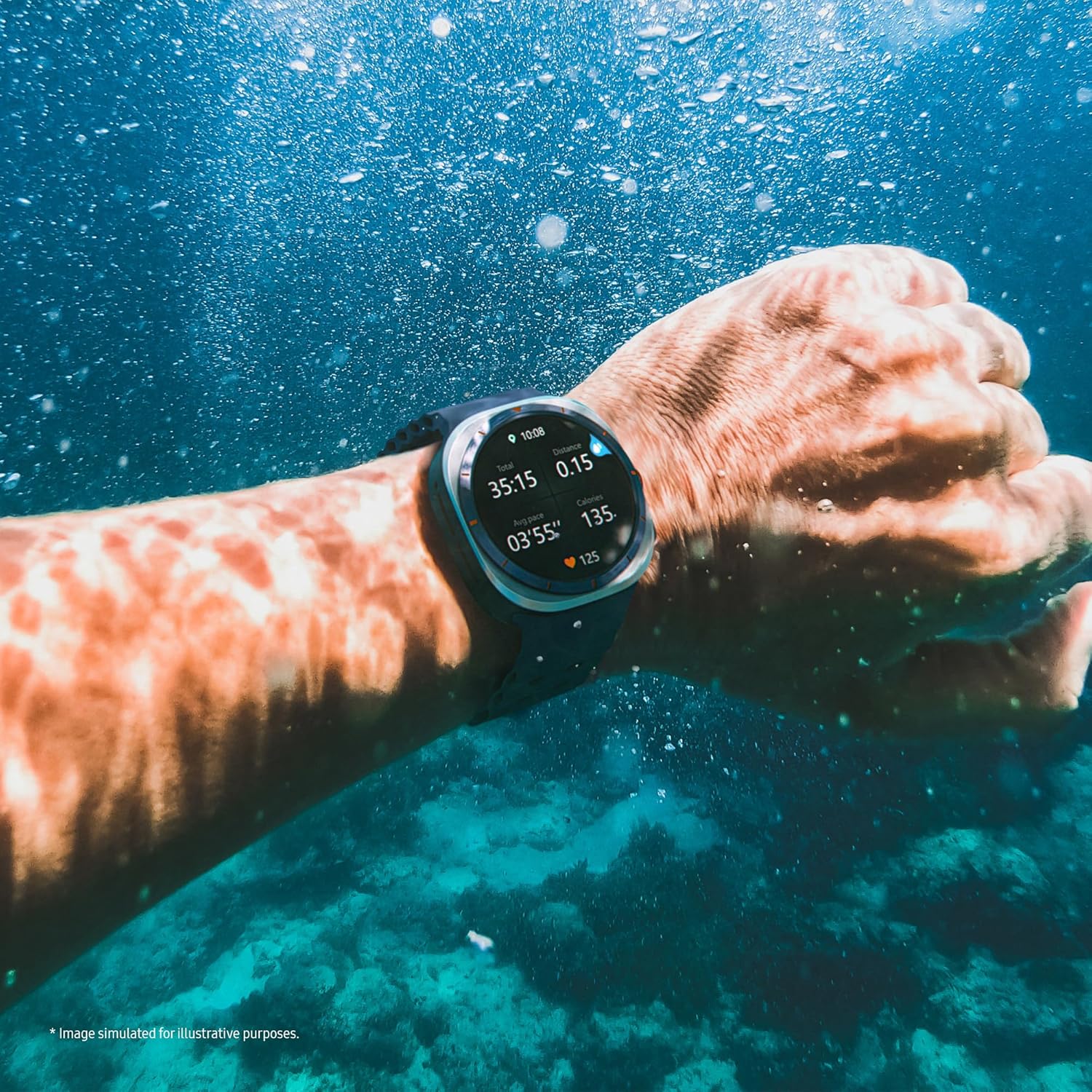
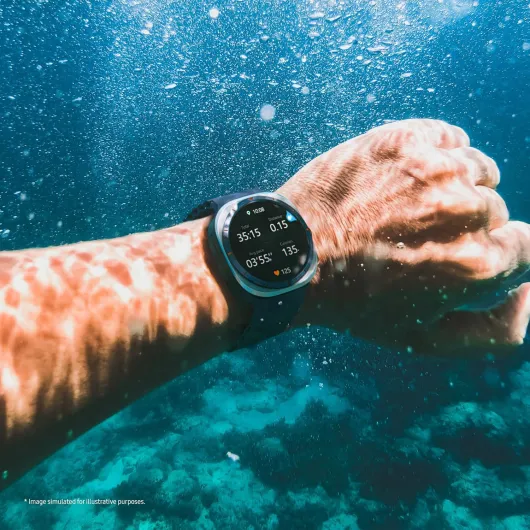
Overall, the materials are pretty solid for a sports-focused watch. Titanium casing, 100 m water resistance, and a band that’s clearly made for getting wet and dirty. It doesn’t feel like a delicate fashion watch, more like gear you can throw on and not worry too much about. If you want leather or steel for style, you’ll probably end up buying a second strap. But as a default combo for training and everyday rough use, it does the job well.
Performance and features: fast, packed, but app-juggling
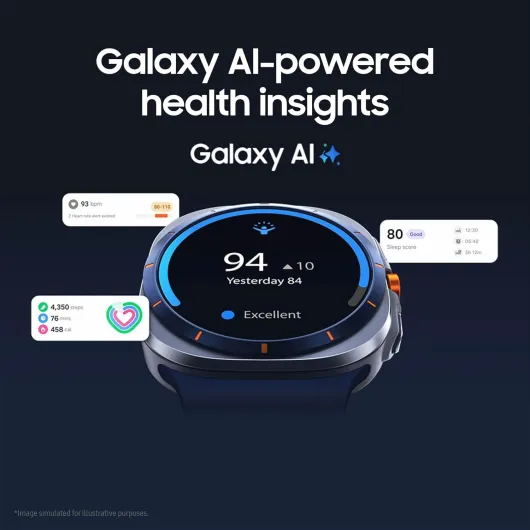
In daily use, the performance is smooth and responsive. One UI 8 on top of Wear OS feels fast, apps open quickly, and the multi-info tiles plus the Now bar are genuinely useful. Swiping between widgets for weather, heart rate, calendar, and workouts is quick, and the rotating bezel makes it even easier. I never really hit lag or stutters, even with notifications coming in, music controls active, and workout tracking running.
Health and fitness tracking are one of the strong points. The watch auto-detects walks almost instantly, which matches what some Amazon reviewers said. I’d step out for a walk, and within a minute or so it would buzz and log it. Runs and other workouts are easy to start manually, and GPS lock was quick in my tests. The running coaching and “running capacity” metrics feel more like nice extras than life-changing features, but they’re handy if you like data. Sleep tracking is fairly detailed, with sleep stages, snoring detection (if enabled), and those little “missions” to improve your habits. Some of it is a bit gimmicky, but the core data (time asleep, wake-ups, resting heart rate) is useful.
The big downside is the software ecosystem mess. You need Samsung Wearable for general settings, Samsung Health for most health data, and Samsung Health Monitor just for BP and ECG. That’s three separate apps, plus whatever Google apps you use. It works, but it feels fragmented. One Amazon review mentioned the watch randomly disconnecting and needing a full setup again; I only had one minor connection hiccup, but I can see how that would be painful if it happens more often. You’re very much locked into Samsung’s way of doing things here.
LTE performance is good once it’s set up. The watch holds a mobile signal fine, calls are clear enough on the wrist, and Samsung Pay works reliably. The catch is that eSIM support depends on your carrier, and some (like VOXI, as one user found) don’t offer watch eSIMs at all. So you might need to switch providers or just accept using it as a Bluetooth-only watch. Overall, performance and features are strong, but you pay for it in complexity and setup time.
What you actually get with this Galaxy Watch Ultra
On paper, the Galaxy Watch Ultra (2025) is Samsung’s big boy smartwatch: 47mm case, titanium build, LTE, 64 GB storage, dual GPS, 100 m water resistance, and all the health stuff you’d expect (heart rate, sleep, blood oxygen, vascular load, etc.). It runs Wear OS with Samsung’s One UI 8 on top, so you get the Google Play Store, Google apps, plus Samsung’s own bits like Health, Pay, and the new Galaxy AI features with Gemini. It’s basically a tiny Android device on your wrist, not just a glorified step counter.
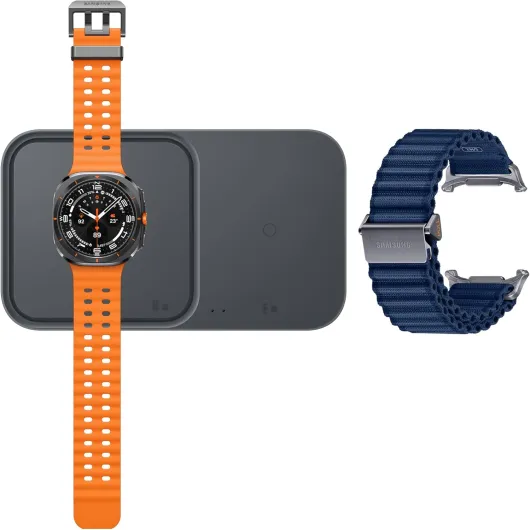
The box is pretty barebones: you get the watch, the orange marine band (titanium hardware), and a charging cable. No charging brick, no spare band, nothing fancy. For the price, I would have liked at least an extra basic strap, because that bright orange band is not exactly subtle for work or formal events. The watch itself feels premium, but the unboxing is fairly basic and practical, nothing more. It feels like Samsung assumes you’re already in their ecosystem and don’t need any hand-holding.
Feature-wise, it tries to do a bit of everything: fitness tracking with coaching for running, auto-detected walks and workouts, sleep tracking with “missions” and coaching, and the usual smart stuff like notifications, calls on the wrist, Samsung Pay, and quick replies. LTE means you can leave your phone at home, as long as your carrier supports watch eSIMs. That bit is important, because not all of them do, and setting it up is not just a one-click process in real life.
Overall, the watch is pitched as this all-in-one device for fitness, health, and day-to-day life. In practice, it delivers on most of that, but you feel the complexity. You’re juggling three Samsung apps (Wearable, Health, Health Monitor) plus Google stuff, and you need to be okay with that. If you want simple and minimal, this is overkill. If you like digging into menus and stats, there’s a lot to play with here.
Pros
- Robust titanium build with bright 1.5" AMOLED screen and 3000-nit visibility
- Strong fitness and health tracking with fast auto-detected walks and detailed sleep data
- LTE, Samsung Pay, and quick button make it practical as a phone companion or occasional phone replacement
Cons
- Battery life around 1.5–2 days with full features, far from the advertised 13-day figure in real use
- Complex setup and app ecosystem (Wearable, Health, Health Monitor) plus eSIM depends on carrier support
- Large 47mm case and chunky band can feel bulky and uncomfortable on smaller wrists
Conclusion
Editor's rating
The Samsung Galaxy Watch Ultra (2025) is a strong smartwatch if you know what you’re getting into. It’s big, bright, and packed with health and fitness features. The titanium case and marine band feel tough, GPS and workout tracking are reliable, and the screen is easy to read in any light. One UI 8 with the rotating bezel makes navigation smooth, and LTE plus Samsung Pay turn it into a decent mini-phone on your wrist when your carrier supports eSIMs. For a Samsung phone owner who actually uses these features, it’s a solid daily tool.
On the flip side, it’s not exactly simple. You’re dealing with three different Samsung apps for setup and health, eSIM activation that depends heavily on your provider, and a watch that you’ll feel on your wrist, especially if you have smaller arms. Battery life is acceptable but nothing more: about 1.5–2 days with Always-On and full features, longer only if you start turning things off or using power saving. Considering the price, there are cheaper Galaxy models or rival brands that might suit casual users better.
I’d say this watch is for people who want a serious, feature-heavy smartwatch, already use a Samsung phone, and are okay charging it frequently and living with a chunky device. If you just want basic tracking, long battery life, and minimal fuss, you’ll probably be happier saving money with a simpler model or a brand that focuses more on endurance than on smart features.